Productivity conversations usually focus on distractions, meetings or time management frameworks.
But there is a quieter issue emerging in modern work environments. Calendar fragmentation.
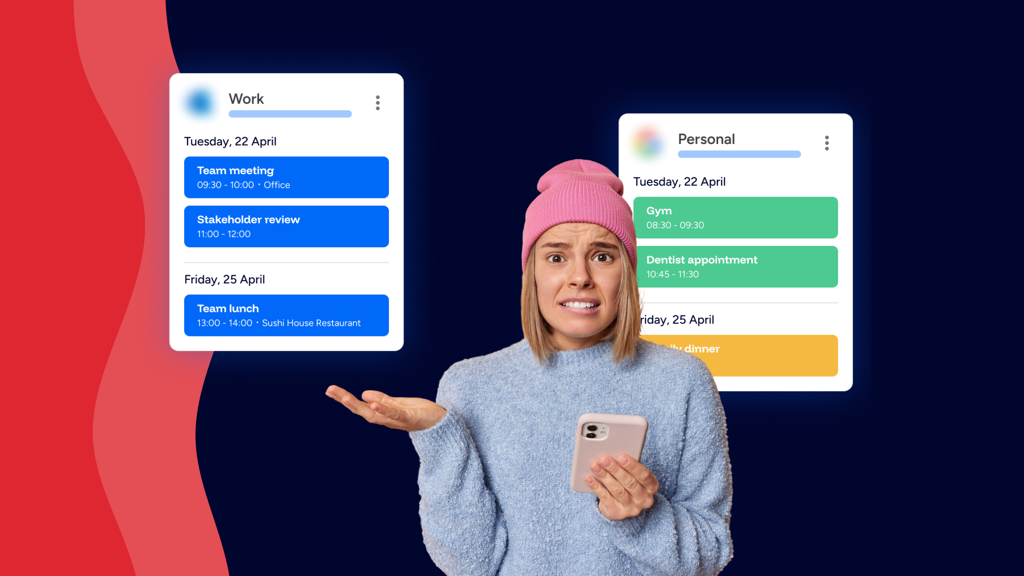
As professionals juggle multiple platforms, accounts and tools, their schedules are no longer housed in one clear system. Work calendars live in one place. Personal commitments in another. Client bookings somewhere else. Individually, these systems work. Together, they create friction.
Calendar fragmentation may be the next major productivity problem, especially for remote teams and growing organisations.
What calendar fragmentation actually looks like
Calendar fragmentation happens when your time is spread across disconnected systems.
You might use:
- A work Outlook account
- A personal Google Calendar
- A shared team calendar
- A booking tool connected to only one account
Each tool captures part of your availability. None of them show the full picture.
This forces you to mentally reconcile your schedule every time you accept a meeting or plan your week. That invisible coordination effort is where productivity starts to erode.
The hidden productivity drain
Fragmented calendars create small inefficiencies that compound over time.
You double-check availability before confirming meetings. You hesitate before accepting invites. You reschedule because another account had something blocked. Each interruption breaks focus.
Instead of relying on one trusted system, you rely on memory and manual cross-checking. For individuals, this reduces deep work capacity. For teams, it slows collaboration.
Calendar fragmentation does not look like chaos. It looks like minor friction repeated daily.
Why remote teams feel it more
In distributed environments, visibility is essential. Teams rely on calendars to coordinate across time zones, functions and projects.
When calendars are fragmented, availability becomes unreliable. Team members cannot confidently see who is free. Meetings require more back and forth. Planning becomes reactive.
Without proper calendar syncing, managing multiple calendars becomes a constant coordination task rather than a background system.
For remote teams, this friction directly impacts productivity and alignment.
The shift from time management to system management
Many professionals try to solve calendar fragmentation with better time blocking or stricter routines.
But the issue is not discipline. It is infrastructure.
When your calendar system is fragmented, no productivity method will fully compensate. You need alignment between platforms before you can optimise how you use your time.
This is where structured calendar syncing becomes important. Connecting multiple calendars ensures your availability is consistent everywhere it needs to be.
Instead of managing gaps between systems, you manage your time intentionally.
Why this problem is growing
As work becomes more flexible, people use more tools. Contractors use client accounts. Founders use multiple inboxes. Teams adopt different platforms.
The modern work environment encourages multiple calendars. Without integration, fragmentation increases. What used to be a minor inconvenience is becoming a structural productivity issue.
Solving calendar fragmentation before it scales
Addressing calendar fragmentation does not require replacing every tool. It requires ensuring they communicate properly.
When availability is aligned across accounts, scheduling conflicts decrease. Confidence in your calendar increases. Team coordination improves.
Tools designed for calendar syncing, such as Am I Free by Shft, help reduce fragmentation by connecting multiple calendars without merging them into one confusing stream.
The goal is not simplification through elimination. It is simplification through alignment.
Final thoughts
Productivity is not just about how you use your time. It is about whether your systems support how you use your time.
Calendar fragmentation introduces uncertainty, friction and preventable errors. Left unchecked, it quietly reduces individual focus and team efficiency.
Recognising it as a real productivity problem is the first step. Aligning your calendars is the second.